Author: Marcel Neunhoeffer
Status: Available on GitHub
Overview
A tabular foundation model is a neural network pretrained on millions of synthetic datasets. You do not train it on your data. You condition it on your data: the training rows go in alongside the rows you want predictions for, and a single forward pass returns a full predictive distribution, with nothing to tune. On small and medium tables these models are often competitive with a tuned gradient-boosted tree.
tabfound runs eight open-weight tabular foundation models behind one R
interface: a formula, a data frame and predict(). Every forward pass is
pure R torch, so the models also work inside secure data environments
that hold administrative data and do not allow a Python installation.
library(tabfound)

fit <- tabfound(Species ~ ., data = iris[train, ], model = "tabpfn-v2.5")
predict(fit, iris[test, ])                  # predicted classes
predict(fit, iris[test, ], type = "prob")   # class probabilities

fit <- tabfound(mpg ~ ., data = mtcars[train, ], model = "tabpfn-v2.5")
predict(fit, mtcars[test, ], type = "quantiles",
        quantiles = c(0.05, 0.5, 0.95))     # prediction intervals
The models
| Model | Publisher | Parameters (classifier) | Weights licence |
|---|---|---|---|
| TabPFN v2.5 | Prior Labs | 10.7 M | Prior Labs licence |
| TabPFN v2.6 | Prior Labs | 10.7 M | non-commercial |
| TabPFN v3 | Prior Labs | 53.2 M | non-commercial |
| TabPFN v3.5 | Prior Labs | 219.0 M | research only |
| TabICL v2 | soda-inria | 27.6 M | see the model repository |
| TabFM 1.0 | Google Research | 1.64 B | non-commercial |
| Mitra | AutoGluon | 75.7 M | Apache-2.0 |
| Kumo Tabular (small, medium, large) | NVIDIA | 27.5 M, 61.5 M, 213.7 M | OpenMDW-1.1 |
The package is MIT-licensed, but the weights are not: check a model’s
licence before you publish or deploy with it. list_models() shows each
one.
Checked against the original. Each model is a port of the published network and of the Python package around it (preprocessing, ensembling and output), tested stage by stage against the reference implementation. Predicted probabilities typically agree to about 1e-6, the floating-point noise of the network itself.
Beyond prediction
Because every model returns a predictive distribution rather than a point
estimate, tabfound can use it as the model inside other methods:
- Multiple imputation.
tabfound_impute()runs chained equations with a foundation model as the imputer, and works withmice(pooling with Rubin’s rules, ormethod = "tabfound"insidemice()) andAmelia. In the package’s simulation study, TabPFN removes the bias that outcome-dependent missingness puts into complete-case analysis. - Synthetic data.
tabfound_syn()generates a synthetic dataset one variable at a time, the waysynthpop::syn()does, and works withsynthpop’s utility and comparison tools. - Large tables. Memory estimates before a fit, KV caching, chunking and GPU support, with a guide to how large a table fits on an 8 to 64 GB machine.
Architecture gallery
tabfound can draw the network of every model it runs, from the network
itself: plot_architecture() in five styles, and plot_architecture_diff()
for two models side by side. The architecture gallery
shows all of them in four of those styles, at both levels of detail and in
both themes.
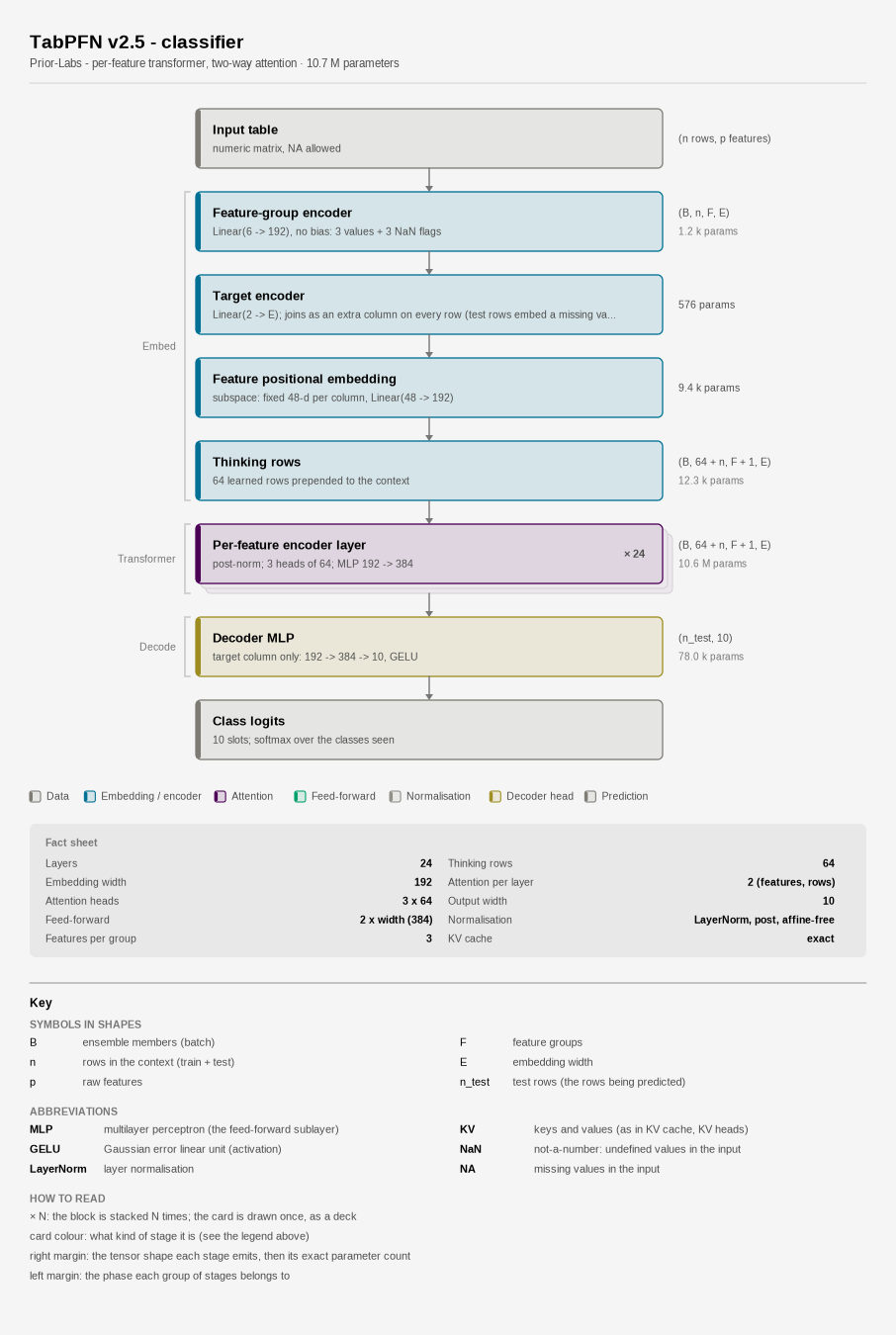
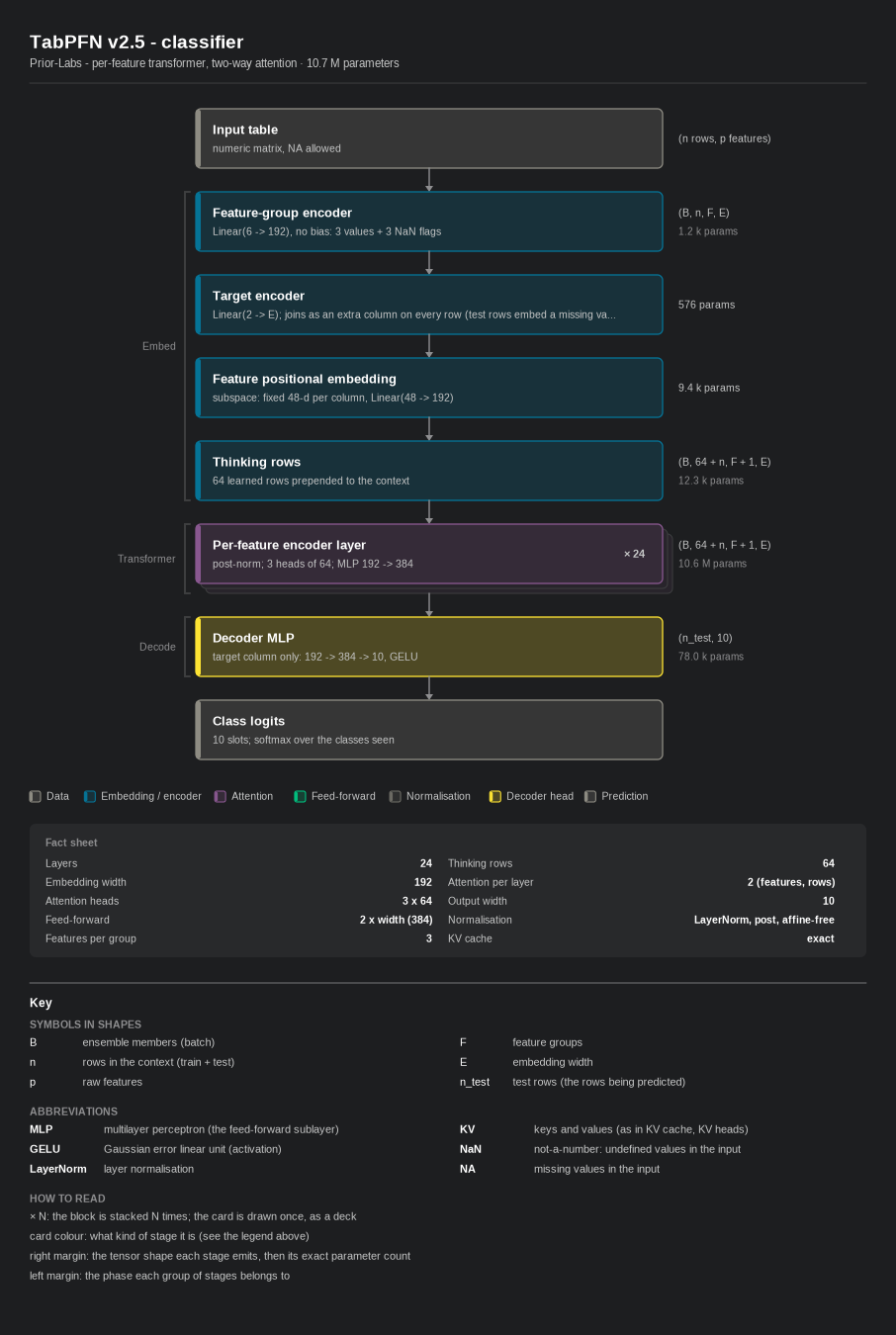
plot_architecture(). Open the gallery →Research
The package accompanies my working paper “Learning from Small Data: Tabular Foundation Models for Political Science”, which evaluates TabPFN as the prediction step in forecasting, double machine learning and multiple imputation.
Installation
# install.packages("remotes")
remotes::install_github("mneunhoe/tabfound")
torch::install_torch()   # once, if you have never used torch
The first time you use a model, tabfound asks before downloading its
weights, and loads them by name, offline, from then on. TabPFN, TabICL and
Kumo Tabular publish weights in a PyTorch format, so their download
converts them once with a Python interpreter that has torch and
safetensors. After that step, Python is never used again.
Documentation
The package vignettes, on GitHub:
- Getting started: a longer tour, with worked examples and a comparison to
lm() - Multiple imputation and synthetic data
- How big a table?: memory and table size, per model
- Advanced use: ensembles, the matrix interface, and known limitations per model
- Architecture gallery: the diagrams, and how to add a new model